News

Search For:

How To Attend And Speak At Legislative Hearings For Montana Pro-Gun and Anti-Gun Bills | From Gary of MSSA

Find some great advice for attending and speaking in support of pro-gun bills or in opposition to anti-gun bills being heard before legislative committees during legislature from Gary Marbut of The Montana Shooting Sports Association embedded from PROGUNLEADERS.ORG below.

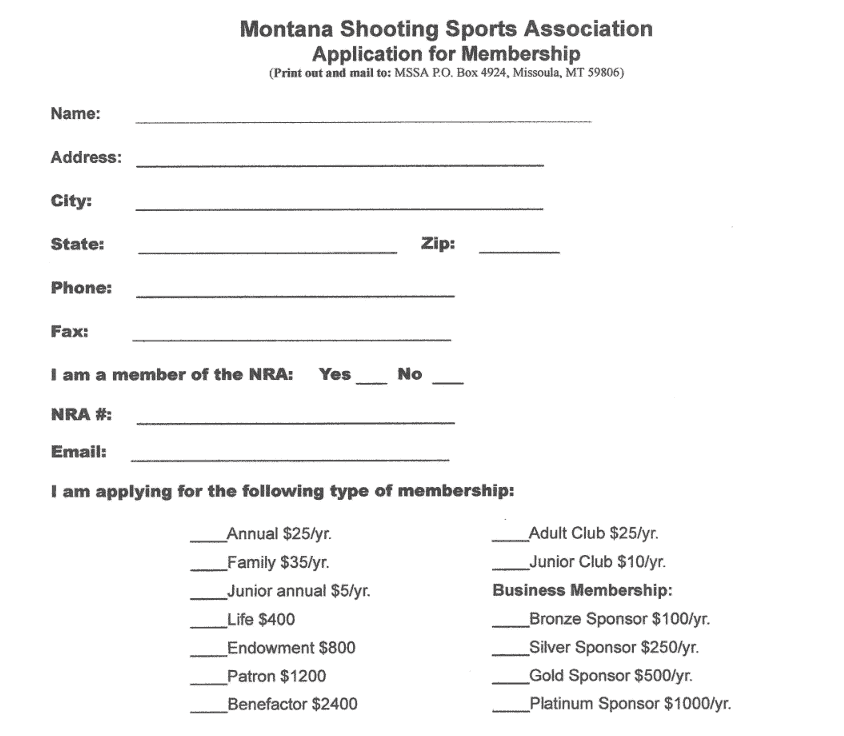
Montana Shooting Sports Association

by Gary Marbut

Attending public hearings on bills before the Montana Legislature

Speaking for or against a bill at a public hearing on the bill is the most persuasive thing a citizen may do to affect the outcome of the bill. It is not difficult to support or oppose a bill at public hearing, but the interested citizen must show up at the right time and place to do so. This brief should give you the information you need to attend and to speak.

Public hearings are held by the committee of the House or Senate to which a bill is assigned by leadership. Most MSSA bills tend to be assigned to the Judiciary or Fish and Game committees of the House and Senate.

Who may attend and speak. Any Montana citizen may attend public hearings, either to simply listen, or to speak for or against a bill.

Where to go? The Legislature meets in the State Capitol building in the southeast quadrant of Helena, near I-15. The Capitol dome is visible from most of that part of Helena. Each committee has a room in the Capitol that it normally uses for business and for public hearings. This room number is listed on the Legislature’s Website for each committee. This information for the House of Representatives is located at: (Click House); and for the Senate at: (Click Senate)

For example, the House Judiciary Committee meets in Room 137 of the State Capitol building. In the room number, the first digit identifies the floor of the Capitol, so Room 137 is on the first floor. Rarely, for a bill of significant interest a committee chairman will schedule a public hearing on a bill for a larger room than the normal committee hearing room.

When to show up. The official hearing time for a bill is the announced start time for the committee (also available from the Website). For example, the House Judiciary Committee meets at 8 AM, Monday through Friday. Plan to be in the Capitol and in a seat in the hearing room by at least 10 minutes before the committee convenes. You may have to wait while the committee conducts public hearings on bills other than the one you’re there for.

Parking. Finding a parking spot in the Capitol area can be a pain. Add 20 to 30 minutes to your overall schedule to locate a parking spot and get into the Capitol building. You may luck out and find a convenient parking place, but probably not. Parking is a challenge. Most public parking for the Capitol is on the South (uphill) side of the Capitol building.

The bill(s) for which you are present may or may not be the first bills up on the committee schedule. Just wait, quietly. It could take as long as two hours for the hearing to begin on the bill of interest to you, but normally not that long.

What to do. Before you enter the committee room, TURN OFF YOUR CELL PHONE or pager. If your phone rings while the committee is in session, it is hugely embarrassing for you (everybody stares at you and smirks) AND you become obligated to buy delivered donuts for the whole committee. Get into the committee room early and stake out a seat. You can reserve a seat by putting your briefcase or coat on it. Minimize conversation inside the hearing room. After the committee session starts (committee “comes to order”), there should be NO conversation at all inside the hearing room above the softest whisper. This is a respect thing for legislators and others attending the hearing. If you MUST talk with somebody, leave the hearing room quietly and have your conversation outside in the hallway. Even then, keep the volume down. Loud conversation in the hallway tends to interfere with business in the committee room.

The process. The committee chairman will call the committee to order and announce the agenda, which will include the order in which bills will be heard. There may be some brief committee “housekeeping” business or announcements. Then the chairman will begin the public hearing process. Here’s how that works:

The committee chairman will announce the opening of the public hearing on a particular bill. The bill sponsor (legislator carrying the bill) will come to the podium and microphone and introduce himself or herself, will introduce the bill to the committee members, will reserve the right to speak last (“close”) on the bill, and will surrender the microphone. The chairman will then call for proponents for the bill, who will come to the microphone one at a time (more about this later). Then the chairman will call for opponents of the bill to speak. Then the chairman will ask for “informational witnesses” – those with information to provide but who are not either for or against the bill.

Then the chairman will ask if there are any questions by any committee members for anyone who has spoken on the bill. This can be very interesting as committee members attempt to skewer those witnesses who disagree with the member with hostile questions. And, others on the committee will ask questions of witnesses they agree with, trying to underscore arguments favorable to their position. Although hostile questions are hostile in nature, decorum is maintained throughout. If you have spoken on the bill, you incur an obligation to stay in the room for questions, in case any legislator has a question for you. Stay in the hearing room until the hearing on your bill is done.

Finally, after all witnesses have spoken and all questions have been asked and answered, the chairman will invite the bill sponsor to “close” on the bill. The sponsor will have been taking notes of opponent testimony and will attempt to refute claims and arguments made by opponents, and will hit again on major points in support of the bill. Then the chairman will close the public hearing on the bill. The committee will then proceed to other business, including public hearing on other bills.

The committee will usually not take action (called “executive action”) on a bill that day. On a subsequent day (usually) during executive action, committee members will debate the merits of the bill, may offer and vote on amendments, and will vote whether or not to pass the bill.

How to dress for a hearing. Dress neat and clean. You want to be a good representative of your position. Common dress is business or business casual. Guys should wear some sort of neck wear. Standard ties are most common, but bolo ties, Apache ties, and neckerchiefs are not uncommon.

Decorum/demeanor. Always be polite, both to legislators and to opponents. If you feel strongly, it is perfectly appropriate to say, “I feel very strongly about this.” But, do not raise your voice, interrupt, or use bad language. Remember that all people have good intentions. People on both sides of a controversy believe they are the ones wearing the white hats. Never challenge the intentions of others. Challenge their facts, challenge their opinions, challenge their conclusions, but not their intentions.

On bills where you appear as a proponent, since proponents go first in hearings, you will have NO opportunity during the hearing to challenge arguments made by bill opponents. That’s just the breaks and how the process works. But, do feel free to make notes about opponent testimony. You CAN contact committee members later, when they adjourn the committee, by phone, by email, or by mail, to refute any refutable claims by opponents. If you’re clever and can predict arguments opponents are likely to make, you can always raise those during proponent testimony by saying something like, “Opponents will probably argue that [then state probable opponent argument]. I want to inform you that [counter the imagined argument].”

Order of appearance. Among bill proponents, there will usually be a “lead proponent,” someone especially familiar with the bill, like myself for MSSA bills and the representative for the NRA. Give the lead proponent a chance to go first. Then be prepared to go promptly to the microphone when the chairman calls for “further proponents.”

How to speak to the committee. Be brief! BE BRIEF!! Committee members spend hours sitting through such testimony. It is said that you can “talk a bill to death” by talking too long. It is not uncommon for a committee chairman to announce a fixed time for proponents and for opponents at the beginning of a public hearing on a bill. Don’t hog the available time so others can’t speak. If you agree with testimony offered by others, just say, “I agree with all the points mentioned by other proponents.” Then say, “I’d like to raise one (or two) additional point(s). Plan to spend no more than two minutes at the microphone – one minute is better.

What you say. All comments are made to and through the chairman. When you go to the microphone, the first thing you say should be, “Mr. Chairman and members of the committee.” Or, “Madam chair and members of the committee,” if a woman chairs the committee. Then, introduce yourself. “I am Joe Blow from Roundup.” Spell your name, for the record. After that, give just a bit more information to qualify yourself, such as “I am a lifetime gun owner and hunter.” Be sure to include in your introduction any positions you hold that may be applicable, such as “I am the president of the Liberty County Sportsmen with 400 members in Liberty County, and I speak for them.”

After introducing yourself, say “I rise in support of (or opposition to) (name of bill, i.e. House Bill 100).” Then speak of your reasons for support or opposition. Then, when you are finished, ask committee members to support (or oppose) the bill. Say, “Mr. Chairman and members of the committee, please support (bill name – i.e., House Bill 100). Thank you for that support. I’d be glad to answer any questions.” Return to your seat. Any questions will come later.

Personal testimony is more persuasive than generic comment. For example, you might say, “This bill is important to me because …” and cite some personal experience.

Again, keep this under two minutes, or even under one minute.

Nervous? Of course. It is impossible to not be somewhat nervous. Just forget that, it comes with the turf. But, try to appear relaxed and confident. One beauty of the Montana Legislature is that the people you are speaking to are just ordinary people, come to Helena every two years to do the peoples’ business. Speak slowly to them, because you don’t want them to miss what you have to say. Use short sentences. Speak colloquially and casually – speak “from the heart”-, as you would speak to a gathering of friends. If you have personal experiences to relate that underscores your position, those personal experiences are VERY helpful and persuasive, BUT KEEP THEM SHORT!

Written testimony. NEVER!!! read to a committee from written testimony. This is offensive to committee members. If you have anything in writing, you can state during your testimony that you have written testimony to present to the committee, then give a copy to the committee secretary at the conclusion of your testimony. Or, you can come equipped with enough copies to pass out to committee members plus the committee secretary. Ask the Chairman for permission to pass out material to committee members. Do this after you speak, so committee members will be listening to you, not reading your material, while you speak. However, legislators have SO much stuff to read that it is unlikely that they will be able to attend to written testimony, especially if it is long (multiple pages). So, don’t count on written testimony to make your point.

Questions from committee members. If you should be called back to the podium for a question from a committee member, remember that all conversation goes through the chairman. So, when you respond, you should say, “Mr. Chairman, Representative X (whoever asked you the question – last name – they all have name placards on the table in front of them), ….” (Or “Senator” if it is a Senate committee.) If you aren’t up to speed on the last name of the legislator asking the question, it is OK to refer to them as just “Representative” or “Senator” without the last name, but “Mr. Chairman” should always come first. Better to focus on giving a lucid answer to the question rather than devoting distracting effort to figuring out the name of the question asker.

Also, if you don’t feel you can give a good answer (especially for what may be a hostile question), you can always defer the question to somebody else. Just say, “Mr. Chairman, Representative (last name if you know it), I don’t have the information to give you an answer and I’d like to defer that question to (whomever you think can answer it well, such as the representative from the NRA or MSSA).”

After the conclusion of a hearing on a bill, there will be a pause in proceedings before the next committee business while people there for that bill file out of the room. DO NOT talk in the hearing room or get into loud conversations in the hallway immediately outside of the hearing room. If you wish to have conversations with others, walk away from the door to the hearing room. The committee probably has other business to conduct and will appreciate the quiet.

Follow-up. If you wish to stress any points raised in the hearing, or to cover any points not covered there, you can probably find the legislator you wish to address in a hallway somewhere for a short conversation, or follow-up by email, mail, fax, or phone. Follow-up is always a good idea. You can use that to refute points raised by the other side, or to offer a more considered answer to a question raised by a committee member.

End

Also check out how to testify at Have Your Say Montana – Montana State Legislature at https://leg.mt.gov/session/have-your-say/

Have you ever spoken publicly at a pro-gun or anti-gun bill committee hearing during a Montana legislative session?
© Kama

Search For:

Community Standards For Member Reviews, Ratings and Comments

Member Ratings & Reviews left on member profile reviews tabs are to be left AFTER transactions. They are indicated by number grades as stars 1-5 and a written review of the transaction.

5 Star: Transaction handled professionally
4 Star: Transaction handled well
3 Star: Transaction handled with minor problems
2 Star: Transaction handled poorly
1 Star: Transactions handled with major problems

The star rating represents the average of all ratings entered for a user by fellow members. The star rating is displayed next to the User Name, and the number within the parenthesis indicates total reviews or ratings shared for the user. Users cannot rate and review themselves and members can leave more than one review for the same member based on transactions.

Rating and title are required but a comment is optional when submitting feedback.
Obscene or libelous reviews or comments are strictly prohibited
Reviews and Comments may not include personal information (Name, address, phone numbers or any identifying information etc.)
Reviews and comments should not include tracking information

We highly recommend and encourage users to leave appropriate feedback for all transactions.

Reviews are useful for helping to evaluate the trustworthiness of a buyer or seller. But we encourage you to perform your own due diligence on a seller or buyer before performing transactions. Click the RED triangle in the bottom right of any review to report it. Please be detailed in your report if necessary.

Search For:

Member Poll: Do Your Support or Oppose Gun Registration In Order To Enforce Universal Background Checks?

We hear frequently from anti-gun entities and politicians that “90% of Americans support Universal Background Checks.” We all know that’s not even close, especially in Montana and that the only way to enforce such a tyrannical law is to require universal firearms registration. It’s more than likely the other way around, especially among Montana gun buyers, sellers and traders. Take the poll and tell us what you think in the comments.

Do You Support or Oppose Universal Gun Registration To Enforce Universal Background Checks?
  • I Oppose Universal Gun Registration in Order To Enforce Universal Background Checks 99%, 147 votes
    147 votes 99%
    147 votes - 99% of all votes
  • I Support Universal Gun Registration in Order To Enforce Universal Background Checks 1%, 2 votes
    2 votes 1%
    2 votes - 1% of all votes
Total Votes: 149
03/22/2024
Only registered users can vote. Login to vote.
© Kama

.

Search For:

Post Free and Featured Gun Friendly Montana Small Business Ads at Montana Gun Trader

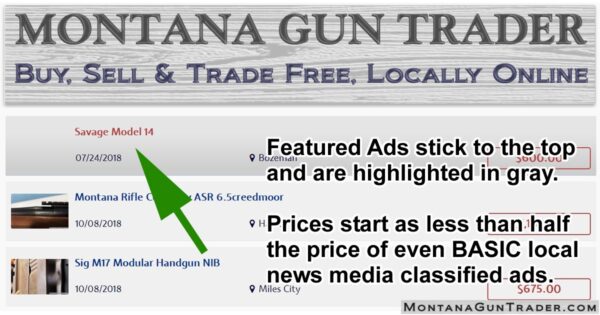
Free posting will always be available for all ads at Montana Gun Trader. Select the Business Category for free and featured ad options. All ads everywhere are always sorted by the very latest ad always at the top. All ads can be renewed in your own Manage Ads page every five days.

Featured Ads in all categories are highlighted and stick to top of all listings pages chronologically with the latest featured ad always at the top. Featured ads also appear below all individual classified ads as well as below all blog post pages like this below and the Sponsor Shop.

Featured Business Ads also appear randomly on the home stream after every second community post getting a ton of community traffic.

Select Montana Business Category when Posting your Free or Featured Business Ads.

Search For:

The Official Montana Right To Keep And Bear Arms Week Begins 1st Monday of March! How Will You Celebrate?

How do you plan on celebrating Montana RKBA Week this year?

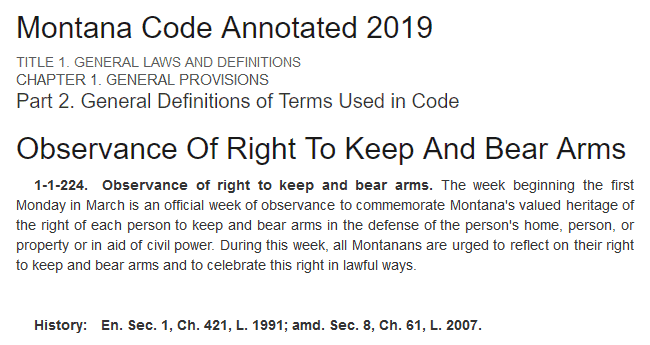
In 1991 The Montana Shooting Sports Association got a bill passed through legislature and signed into law setting the first week starting on Monday every March as the official week for Montana to celebrate our RTKBA – Right to Keep and Bear Arms.

1-1-224. Observance of right to keep and bear arms. The week beginning the first Monday in March is an official week of observance to commemorate Montana’s valued heritage of the right of each person to keep and bear arms in the defense of his home, person, or property or in aid of civil power. During this week, all Montanans are urged to reflect on their right to keep and bear arms and to celebrate this right in lawful ways.

Let me know if you have events planned. I may be able to provide free MSSA and MTGT bumper stickers

Search For:

Watch: Second Montana House Floor Session on HB258 – To Prohibit Enforcement Of New Federal Gun Laws [Video]

After first being tabled in committee because of the opposition from The Montana Sheriff’s and Peace Officer’s Association, HB258 was resurrected and went to it’s second reading on the House Floor on 2/26/21. Watch it below.

HB258 A BILL FOR AN ACT ENTITLED: “AN ACT PROHIBITING THE ENFORCEMENT OF ANY A FEDERAL BAN ON OR REGULATION OF FIREARMS, MAGAZINES, AMMUNITION, AMMUNITION COMPONENTS, or FIREARM ACCESSORIES; and PROVIDING AN IMMEDIATE EFFECTIVE DATE AND A RETROACTIVE APPLICABILITY DATE.”

Find current status and contact appropriate reps to help move it along at https://leg.mt.gov/web-messaging/ Watch and make comments below.

Current Status: HB258 – An Act Prohibiting Enforcement of New Federal Gun Laws

Search For:

Watch: Signing Ceremony Of HB102 Into Law By Governor Gianforte & Explanation of LR130 & HB102 by Gary Marbut

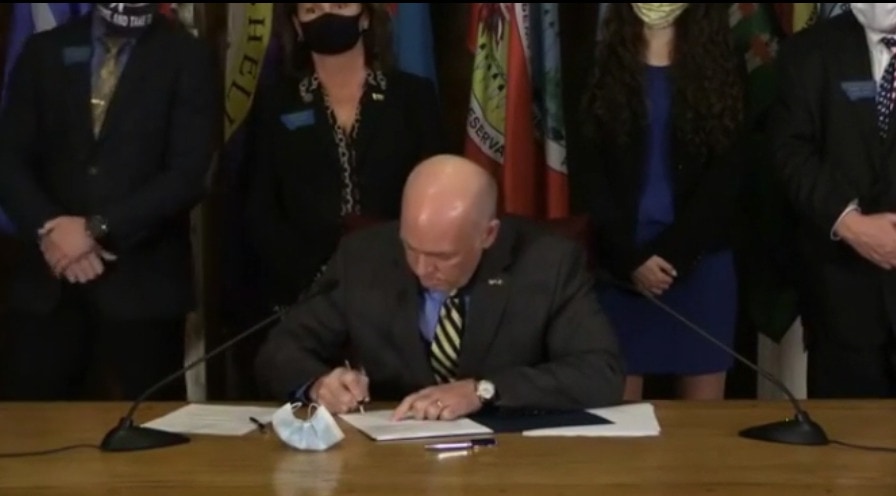
Watch The Signing Ceremony Video Of Montana’s historic HB102 (Permit-less Concealed Carry) Into Law By Governor Greg Gianforte on 2/18/21.

Read and comment on: Effects of LR-130 and HB 102 by Gary Marbut, president of The Montana Shooting Sports Association embedded below.

Search For:

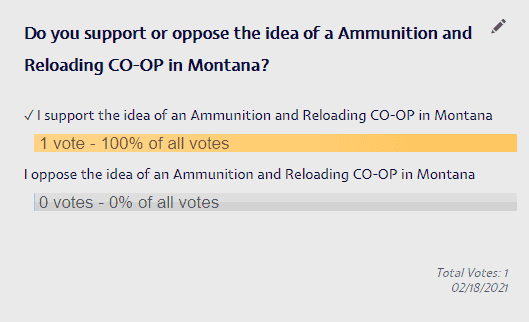
Poll: Do You Support or Oppose an Ammunition and Reloading CO-OP To Give Montana More Ammo Independence?

I’m not sure what that looks like right now but will help in any way I can with this site. Take the poll, discuss and make suggestions below.

Do you Support or Oppose implementing an Electoral College system for Montana Governor and U.S. Reps?
© Kama

Join the Montana Ammunition and Reloading CO-OP Group Here.

Latest Featured Ammunition Ads
1 2 3

Search For:

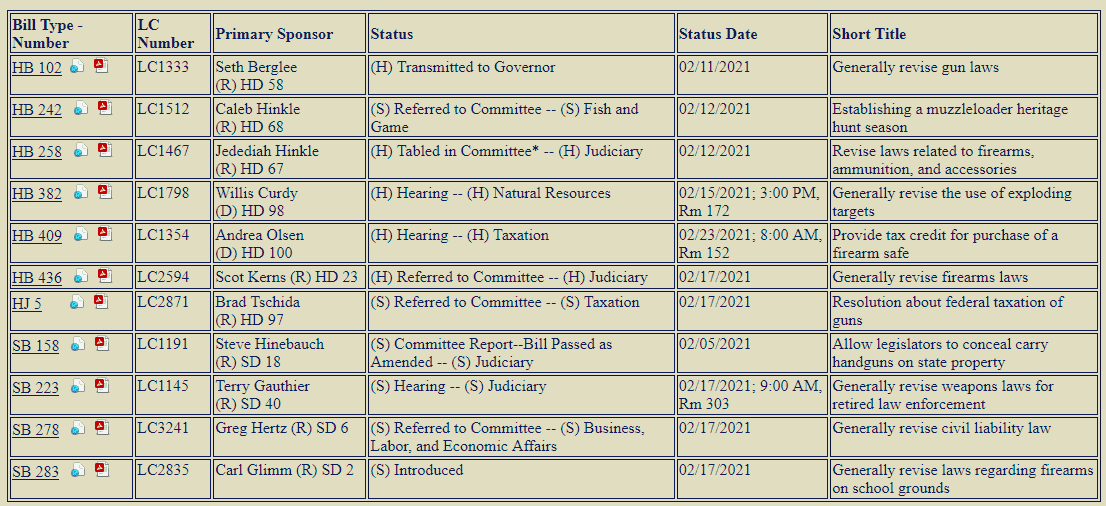
Where do I find the status of MT HB102, HB258 or other Guns and Weapons Bills in Montana Legislature for 2021?

Find the most current status of any Montana Guns and Weapons bills embedded below or directly at the Montana Legislature Bill Search Results Page For “Guns and Weapons” Page. Use the contact form and links below to send messages. Click SHARE above Latest Featured Ads below.

Find tips for contacting legislators written by Gary Marbut at ProGunLeaders.org Titled: Legislative Process – Contacting Legislators – Tracking Bills. Then use the form below to send messages now.

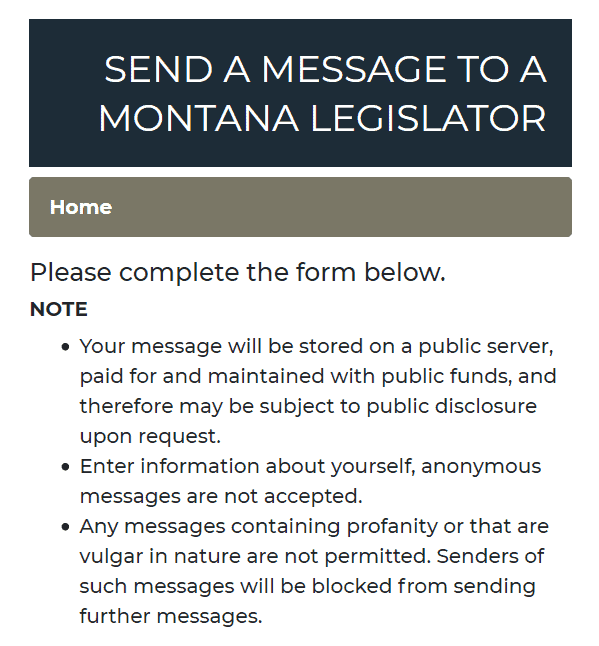
Send messages to legislators and committees through the Montana Legislature Messaging System or the public form embedded below. Click MENU for more options and information. NONE of your information is stored here. Questions, comments and reactions can be made by members below.

Search For:

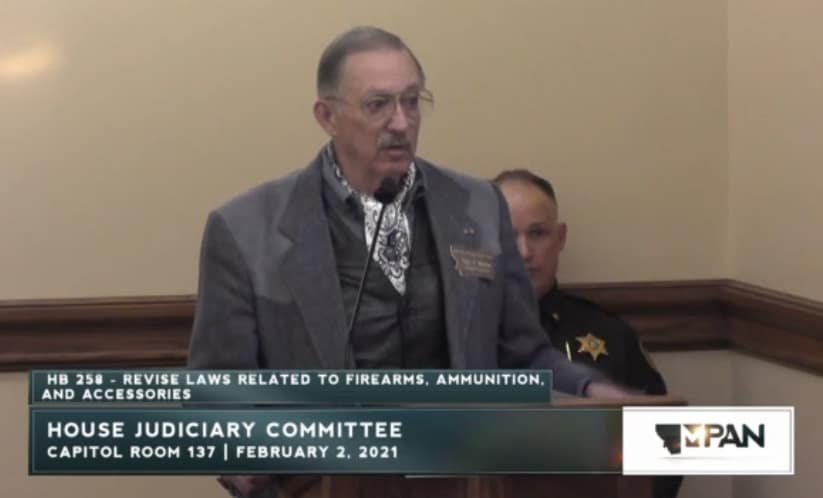
Watch: HB258 in House Judiciary Committee | The Most Important Bill For Montana Gun Owners To Support in 2021

With a current federal government that is going rogue against the United States Constitution and The Second 2nd Amendment, House Bill 258 must become law or all levels of Montana law enforcement will soon be pitted against 70% of the population of Montana who are gun owners.

Watch the hearing and citizen testimonies and questions, then comment below. Use the form below and ask them to Support HB258!

Send messages to the (H) Judiciary Committee below asking them to “Please Support HB258 With ONLY The Sponsors Amendments Please!” using the Montana Legislature Messaging System embedded below. Click MENU for more options and information. NONE of your information is stored here. Questions, comments and reactions can be made by members below.

Search For:

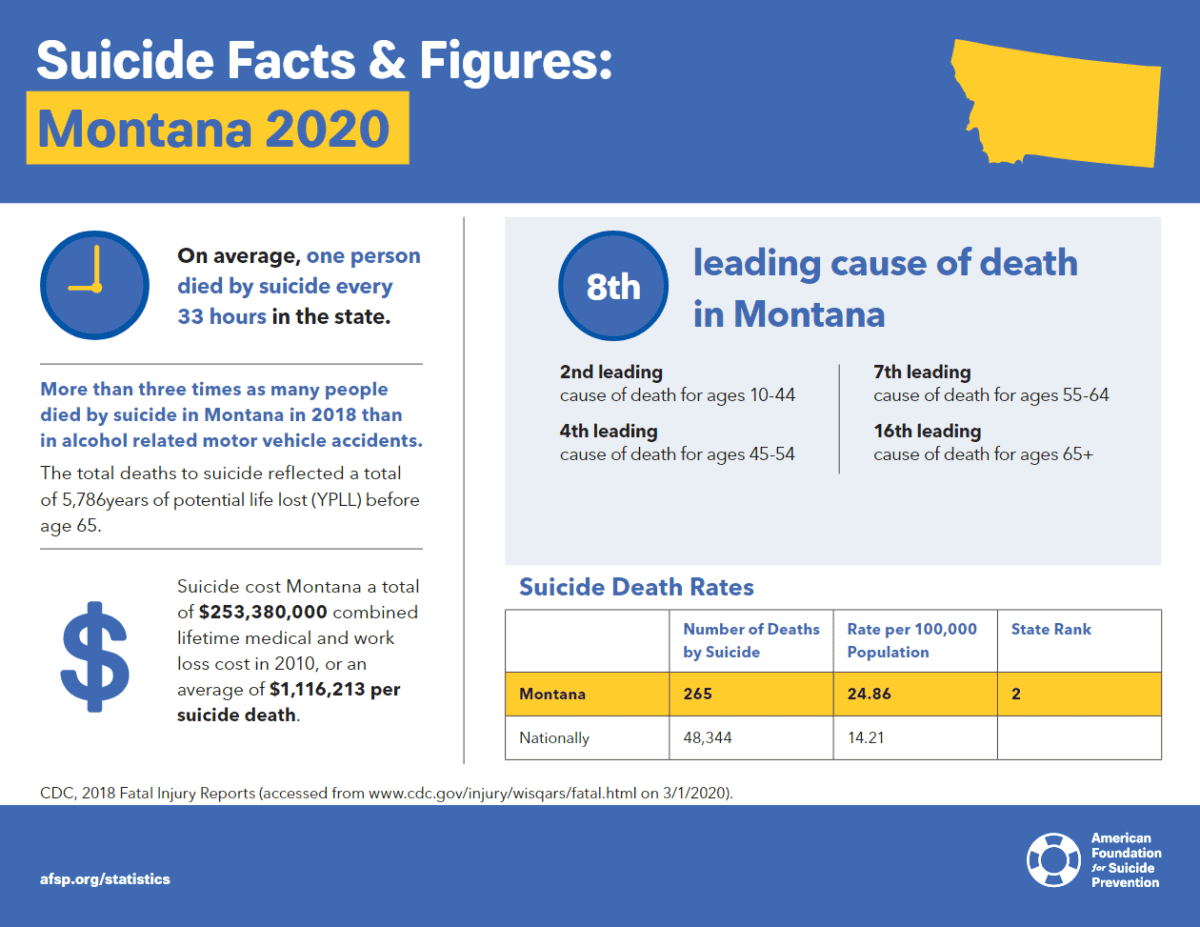
Suicide in Montana is almost twice the national average. Does firearm attainability contribute? Take The Poll

Montana Gun Trader Member Only Poll
Does easier firearms attainability contribute to Montana's almost twice the national average suicide rate?
  • No 89%, 47 votes
    47 votes 89%
    47 votes - 89% of all votes
  • Yes 11%, 6 votes
    6 votes 11%
    6 votes - 11% of all votes
Total Votes: 53
03/22/2024
Only registered users can vote. Login to vote.
© Kama
Click Or Call The National Suicide Prevention Life Line At 1-800-273-8255 NOW If You Are Feeling Suicidal!

Easily the most depressing and influential statistic that Montana gun owners ever contend with in the discussion over more gun control is related to firearms attainability in Montana and successful suicides. How do we as gun owners help justify gun ownership when so many of our friends, family members and neighbors are taken from us with the simple squeeze of a trigger and we have a lot more triggers?

It’s simple and may seem insensitive, but where there’s a will, there’s a way and that’s the way most of us grew up. We all know that someone who is determined to do something will find a way to do it. As insensitive as this may sound, suicide by firearm is common sense at work. Use the best tool for the job.

See Montana Suicide Rate At The American Foundation for Suicide Prevention.

How can we help? Get help if you need it and be sure your guns are inaccessible to those with suicidal tendencies and try to get them the help they need whether they have access to guns or not. They will figure out another way to get the job done. Don’t let it be with your gun!

Click Or Call The National Suicide Prevention Life Line At 1-800-273-8255 NOW If You Are Feeling Suicidal!

Search For:

Make 3% selling ammo online. Affiliate and get a free ammo search form that adds your id automatically.

The search form above is designed to open a Lucky Gunner search result in a new window. Lucky Gunner is an affiliate that has been at the top of Top Ammunition Sites for nearly a decade. Most shooters know Lucky Gunner well. They set standards for online ammo.

When visitors search through that form, find ammo in stock and then and buy it, a 3% commission made helps fund this Montana gun website. Search and buy above or by using these forms found around the site to help keep the lights on at Montana Gun Trader.

How do I make 3% selling Lucky Gunner Ammo?

You can easily make money when ammo is in stock too. Even without a website once approved for Lucky Gunner’s Lucky Referrals Affiliate Program using your Montana Gun Trader profile page url as your website. Copy your Montana Gun Trader Profile Page URL to your clipboard. Then click and paste it in the URL field in this form to become an affiliate at Lucky Referrals. Complete the form and submit, then wait for approval.

On approval, you will receive your referral id. Add that referral id to the end of any URL from LuckyGunner.com. Then share your links, even on the stream or in Montana Gun Trader Groups with that id. When your friends, family or referrals click through and purchase, you will make a 3% commission paid monthly and they pay like clockwork!

Get a search form free

Copy and paste the code below anywhere form html is accepted. Note: It adds our =rid at the end. Meaning we make a commission from sales through that form. It will work as is but if you are already a Lucky Referrals Affiliate, simply change the rid=montanaguns at the end of the URL to your rid= after copying and pasting the code below at your website.

<form action="https://www.luckygunner.com/catalogsearch/result?q=#rid=montanaguns" target="_blank" method="GET" style="display:flex;flex-direction:row;border:0px;padding:2px;margin-top:20px;margin-bottom:20px;"><input type="text" id="q" name="q" placeholder="Search Lucky Gunner" aria-label="Search"><button type="submit"><i class="fa fa-search"></i></button></form>

Search For:

Poll: Do You Support or Oppose Bans on Semi-Automatic Firearms and High Capacity Magazines?

Vote in the polls and share with your friends and family asking whether they support or oppose bans on semi-automatics like AR-15’s or magazine capacities.

Do You Support or Oppose a Ban on Semi-Automatic Firearms?
© Kama
Do You Support or Oppose A Ban on High Capacity Magazines?
© Kama

.

Search For:

Send a message to Montana legislators and committees about active bills and legislation online

Send messages to legislators and committees through the Montana Legislature Messaging System embedded below. Click MENU for more options and information. NONE of your information is stored here. Questions, comments and reactions can be made by members below.

Search For:

Poll: Do you Support or Oppose “Red Flag” Gun Laws in Montana?

Do you Support or Oppose "Red Flag" Gun Laws in Montana?
© Kama


.

Search For:

MontanaGunsForSale.com (was) a scam and fraudulent website pretending to be affiliated to pirate our keywords/SEO

<- This is my original avatar created for MontanaGuns.Org many years ago. You know your website is getting more popular when pirates are trying to tag along for the ride.

MontanaGunsForSale.com was one of the original websites obtained by the founder of MontanaGuns.Org. It was obtained among others to help preserve it from pirating keywords just as the one embedded below does. Unfortunately holding on to it among others is not possible because the cost of doing so. Please donate to MontanaGuns.Org to help preserve the domains we do have from pirating like the one below. I get it, they’re trying to capitalize on our popularity and our organic keywords. These people are dirt bags.


They’ve since taken it down because they realized resistance is futile. Check out MontanaGuns.Org instead.

Search For:

Poll: Do You Support or Oppose The Proposed Great Wall of Montana?

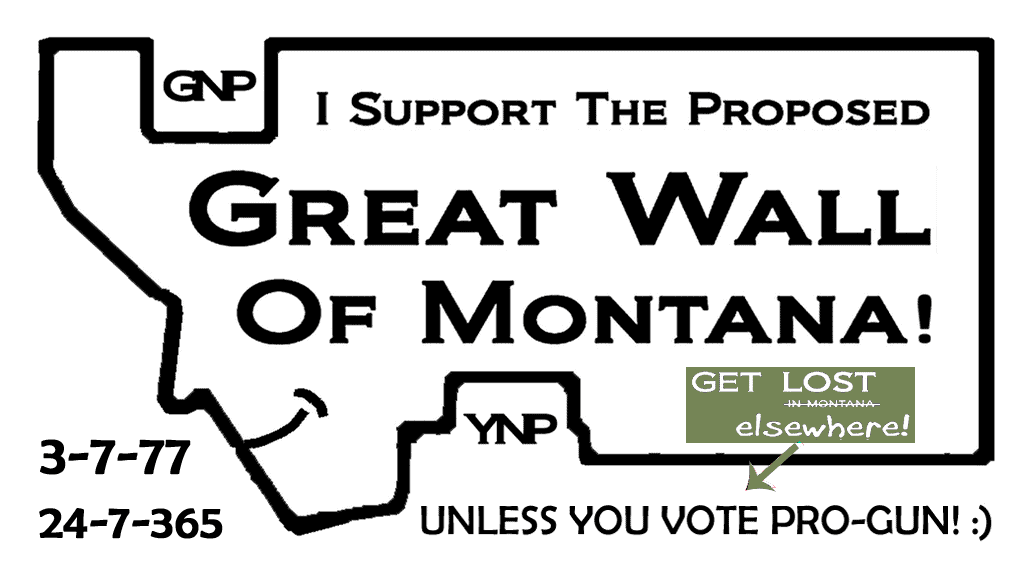
Of course it’s just for fun. Or is it? We can’t stop you from moving to Montana just yet. If you do, we insist that you ALWAYS VOTE and ALWAYS VOTE PRO-GUN and PARTICIPATE WITH your elected representatives every odd year in overwhelming and undeniable force. Insist they vote on bills and legsilation that directly affect your right to keep and bear arms. That’s how we’ve kept Montana pro-gun. It didn’t happen by accident. It takes all of us. Are you part of the problem or the solution? Vote and view logged in member comments on the border wall below. Find out what specifically it means to be pro-gun, click here.

Share

Do You Support or Oppose The Proposed Great Wall of Montana?
© Kama

Search For:

Poll: Do You Support or Oppose The Permit-less Concealed Carry Of Firearms in Montana?

Do You Support or Oppose Permit-less Concealed Carry in Montana?
© Kama

.

Search For:

A Guide to Private Firearms Sales From Pro-Gun Leaders At The Montana Shooting Sports Association

A Guide to Private Firearm Sales
Moral and Legal Responsibilities

Source: http://www.progunleaders.org/privatesales

by Gary Marbut, President
Montana Shooting Sports Association
Author, Gun Laws of Montana

“People have asked me, “As a private firearm seller, what is my responsibility to vet a buyer as an acceptable customer?”

The answer to this has several parts. First, I am not an attorney, so consult with an attorney if you want a more licensed opinion. Second, let’s divide this question into five parts: Moral responsibility, responsibility under state law, responsibility under federal law, potential civil liability, and practical matters.

Moral responsibility. That’s easy. As a moral person and a responsible, law-abiding member of society and gun owner, we do not want to transfer a firearm (or even a car) to another person who would use it to jeopardize or injure an innocent person. We want to have some assurance that the buyer is not a criminal or dangerously careless person, and not flaky or unstable. Thus, it’s helpful in assessing character issues to be selling to someone we know well, personally.

State laws. I’m not an expert on any laws except those of my home state, so the reader will need to incorporate separately whatever his or her home state laws may require or prohibit. Montana laws do not control private transfers of firearms.

Federal laws. 18 USC § 922(d) makes it a crime to transfer a firerarm or ammunition to another person “ knowing or having reasonable cause to believe that such person” is prohibited from firearm possession, specifically:

18 USC § 922(d) says:
(d) It shall be unlawful for any person to sell or otherwise dispose of any firearm or ammunition to any person knowing or having reasonable cause to believe that such person—

(1) is under indictment for, or has been convicted in any court of, a crime punishable by imprisonment for a term exceeding one year;

(2) is a fugitive from justice;

(3) is an unlawful user of or addicted to any controlled substance (as defined in section 102 of the Controlled Substances Act (21 U.S.C. 802));

(4) has been adjudicated as a mental defective or has been committed to any mental institution;

(5) who, being an alien—

(A) is illegally or unlawfully in the United States; or
(B) except as provided in subsection (y)(2), has been admitted to the United States under a nonimmigrant visa (as that term is defined in section 101(a)(26) of the Immigration and Nationality Act (8 U.S.C. 1101(a)(26)));

(6) who has been discharged from the Armed Forces under dishonorable conditions;

(7) who, having been a citizen of the United States, has renounced his citizenship;

(8) is subject to a court order that restrains such person from harassing, stalking, or threatening an intimate partner of such person or child of such intimate partner or person, or engaging in other conduct that would place an intimate partner in reasonable fear of bodily injury to the partner or child, except that this paragraph shall only apply to a court order that—

(A) was issued after a hearing of which such person received actual notice, and at which such person had the opportunity to participate; and
(B)
(i) includes a finding that such person represents a credible threat to the physical safety of such intimate partner or child; or
(ii) by its terms explicitly prohibits the use, attempted use, or threatened use of physical force against such intimate partner or child that would reasonably be expected to cause bodily injury; or

(9) has been convicted in any court of a misdemeanor crime of domestic violence.
This subsection shall not apply with respect to the sale or disposition of a firearm or ammunition to a licensed importer, licensed manufacturer, licensed dealer, or licensed collector who pursuant to subsection (b) of section 925 of this chapter is not precluded from dealing in firearms or ammunition, or to a person who has been granted relief from disabilities pursuant to subsection (c) of section 925 of this chapter.

18 USC § 922(a)(5) makes it illegal to transfer a firearm to a person the seller knows or has reasonable cause to believe does not reside in the state of the seller. This does not include a temporary transfer such as the loan of a firearm for hunting. Here is the specific wording of the federal law:

It shall be unlawful –

(5) for any person (other than a licensed importer, licensed manufacturer, licensed dealer, or licensed collector) to transfer, sell, trade, give, transport, or deliver any firearm to any person (other than a licensed importer, licensed manufacturer, licensed dealer, or licensed collector) who the transferor knows or has reasonable cause to believe does not reside in (or if the person is a corporation or other business entity, does not maintain a place of business in) the State in which the transferor resides; except that this paragraph shall not apply to (A) the transfer, transportation, or delivery of a firearm made to carry out a bequest of a firearm to, or an acquisition by intestate succession of a firearm by, a person who is permitted to acquire or possess a firearm under the laws of the State of his residence, and (B) the loan or rental of a firearm to any person for temporary use for lawful sporting purposes

All of Section 922 is posted at https://www.law.cornell.edu/uscode/text/18/922.

Civil liability. Under the Law of Torts, the general rule is that you are not responsible for the criminal or negligent activities of another person unless you knew or should have known of their intent. That means that the default is you can assume that a buyer’s intent is lawful. However, if a seller is sued by an injured person alleging that the seller knew or should have known that the buyer would likely use the firearm sold to cause the injury, then the question will likely come before a jury to decide. In addition to having to pay an attorney to defend him, the seller could also have a stiff award against him or her and in favor of the plaintiff. Thus, a prudent seller will be cautious when selling firearms. There are ways to make the process safer.

Practical matters. When a private person (not an FFL) is selling a firearm to another private person, there are a number of ways a reasonable and prudent seller can reduce legal and moral risk.

Sell to known people. A person selling a firearm privately will be better off selling to someone the person knows well, if you have confidence that the person is not prohibited under federal law and is not a flaky or unsound person. This might be a neighbor you’ve know for years, a longtime co-worker, or a member of your gun club. Selling to unknown people is where more due diligence is required to keep the seller on safe legal and moral ground.

Other indicators. If the buyer has a currently valid concealed weapon permit, that usually means that the person has recently passed a federal background check and is not a prohibited person under federal law. If you know (for sure) that the person has recently purchased a firearm from a federally-licensed dealer, then the person has cleared the Brady Law background check system and is not a prohibited person. In either case, the prudent seller also will wish to have confidence that the buyer is a solid and stable person, and not flaky or unsound.

General impressions. A seller will want to notice other indicators to determine if a sale to a stranger is copacetic. Is the buyer driving a vehicle with license plates that match his or her claim of residence? Does any identification offered match the buyer? Is the buyer calm and businesslike or nervous and unsettled? With any red flags, it would be prudent to not consummate the sale.

Identification. Many careful people when selling a firearm privately to an unknown buyer will ask the buyer to present identification such as a drivers license, and will write down relevant information from the ID.

Receipt and records. A private seller should also prepare a duplicate receipt for the sale that includes the name and ID type and number of the buyer. It should also include the date of the sale, and the make, model and serial number of the firearm. The buyer should want a copy of this receipt in case the buyer is ever asked to prove that he or she obtained the firearm lawfully. The seller should definitely retain a copy of the receipt. If some law enforcement agent ever comes to the seller claiming that the sold firearm has been retrieved from a crime scene, it will be ever so helpful to have this receipt to document the transfer out of the seller’s possession.

Finally. If all usual vetting fails to get a seller into a comfort zone about a particular buyer, yet the seller really wants to make the sale, the seller can always ask the buyer to meet him at the location of a willing licensed firearms dealer (”FFL”), such as a gunsmith or pawn shop that handles guns, where the buyer can be run through a Brady Law check for the sale. Phone the FFL in advance to confirm availability of and price for this service, which may range from $25 to $60. If the buyer refuses do a transfer via an FFL, then the buyer may be a person the seller doesn’t wish to sell a firearm to. Remember, it’s willing seller, willing buyer.

Depending on your state laws and compliance with these laws and principles, it is perfectly legal and possible for private individuals to sell firearms to other individuals.